Only a few days in, I knew the whole covid thing was a lie.
Not that there wasn’t a virus, I was one of the first people I knew who got it.
I’m not some grand prognosticator, it’s just when you grow up with lies, like in my case where they told me that my younger brother was my uncle, among other things, you get really good at sniffing out the Truth. Or at least that’s the case with me. Some call it hyper-vigilance.
My early tip off was three little words: Shelter in Place. If not for the fact that I’m an elementary school teacher in California, I might not have known exactly what that meant.
Friday the 13th in March of 2020, was the last day that I saw kids at school; playing in the playground, tumbling and touching, laughing with their heads back and mouths open wide, for a long, long, while. Spring break was only a week away, and spring fever was hitting hard. The kids didn’t feel like working, and neither did I. Ms. K, the principal, called us into special meeting that Thursday after school in the library. I was thinking, really? Can’t you just send out an email or something? An extra meeting was the last thing I wanted. On the other hand, it wasn’t too often a special meeting was called, so I was somewhat intrigued.
“The students are not coming to school next week,” she told the assembled, tired-looking teachers, scanning the room for reaction. “We are being told to close an extra week out of an abundance of caution, so that they can get a handle on this virus that is going around.”
At first I thought she meant because so many kids at our school had been sick. Lots of kids had been sniffing and coughing right in my face, and wiping ribbons of snot on the back of their sleeves. I had been working with kids one-on-one on a computer for English proficiency, and had to keep wiping down the screen and keyboard that was sprayed with sneeze spittle. But closing the school just because some kids were sick? That was unheard of. They don’t close school for anything, as much as I wished we could have a snow day or something once in a while, but no such luck in California.
The room full of teachers sat for a full minute of stunned silence trying to digest this news. Ms. K continued, “Governor Newsom has ordered all the schools closed in the seven Bay Area counties, due to the spread of the Corona virus.”
Oh, that? Sure, I had heard of this Corona virus in the background of my busy days, the guy who died in China, the three or however many cases they had detected in the US, mostly by people who travelled to China. I remember people being scared to go to the Chinese New Year parade in San Francisco that past February, but I thought that was ridiculous hype, and went anyway. I had heard that a State of Emergency had been declared, but I thought, yeah, yeah, that’s how they get money. None of the talk meant anything to me until I heard Ms. K say they were going to close the school. All the schools in the Bay Area. For a week!
My first guilty thought: we don’t have to teach next week! Yahooo! And then we still get another week off for spring break? Two whole weeks without the kids, an extra week off? I think I can speak for most teachers when I say that while I love teaching kids, the job is, let’s say, taxing. I adore kids, more than adults, but at that point in the year the extra break was welcome. I could feel this somewhat verboten thought ping-ponging around the worn-out, spring-fevered, teachers’ brains in the room. Though most sat stoically stone-faced, no one would admit the glee I think we all felt until I heard a teacher behind me whisper, “What, is this Christmas? I thought it was Easter!”
“You will all need to report to work next week,” Ms. K went on. “We will need you to help gather materials for the students to use during the extra week they will be at home. Although the kids will not be required to come to school, they will still be considered instructional days.”
Anybody who is a teacher knows that any kind of “work” that doesn’t involve trying to wrangle kids attention, inspire them to learn, keep them following the rules while fostering and independent spirit, making them laugh, consoling their injuries, and loving them at the same time is not work. Any kind of task on a computer screen, or talking on a phone, or doing something menial, does not compare with the spiritual and emotional effort required to turn a classroom of kids into a cohesive community. So, whatever we teachers were going to be required to do the next week felt like an unexpected vacation.
After we were dismissed, some of the teachers buzzed in corners, and a couple of teachers in the principal’s inner circle went up to talk to her in low voices. I thought I heard her say, “Yeah, I don’t think they’re coming back at all this year.” I thought I must have heard that wrong, and put the thought out of my head as being too impossible to fathom. Only later did that overheard remark come back to haunt me.
The next day, on that Friday the 13th there was a palpable grief floating through the kids’ collective psyche, while we teachers were temporarily psyched up. They had definitely gotten the memo about the extra week off, but I was surprised to see kids crying here and there, some clustered in small groups, their arms around each other, heads down. Kids came up to randomly hug me. It felt like a funeral. Actually, it was, but I didn’t know it yet. The kids seemed to intuit what was happening though. “Aw, come on, it’s only a week,” I said to whatever kid was acting overly dramatic, as kids tend to act.
Monday morning, we teachers all reported to an eerily empty school void of kid-noise and energy. The bells rang anyway, signaling nothing. We were told to go through the desks in all the classrooms, and start making packets of work that the parents would later pick up. I set to work in various rooms, putting crayons in baggies, and making stacks of work and books, and packing and marking them in paper bags. About half way through the day on Tuesday, I heard Ms. K make an announcement on the loudspeaker. “Everyone is to go home. Now. Please just drop what you are doing. The governor has announced a Shelter in Place.”
I was like, what? Shelter in Place?
I knew what that term meant, as most teachers do, because ‘Shelter in Place’ was one of the many emergency drills we practiced with the kids every year. Fire drill, evacuate the building, earthquake drill, get under the desk, unfortunately in later years, ‘active shooter’ or lockdown drill, close the curtains, lock and block the door, and keep quiet. Shelter in Place meant do not evacuate, immediately seek shelter in the nearest building or room, and if possible seal the windows and doors and turn off any air conditioning because of immediate danger outside. The danger could be some hazardous chemical material in the air, or else severe weather. Shelter in Place is a command that is only meant to last for a few hours.
This is where the governor made a big credibility mistake with me, very early in the game, and I never believed another word he, or any other person in the government or public health said on the matter. Immediately my hyper-vigilant brain started rapid-fire spitting out questions as it tends to do, often to people’s annoyance. Like the evil covid germs were just floating around outside in the air? Invisible spiky red balls had permeated the atmosphere? Were we supposed to hold our breath on the way out to our car? Was everybody sheltering in place? And for how long? If there was imminent danger, why weren’t we sheltering there at school? And why only the Bay Area?
I went to talk to Ms. K, being mindful to only ask a fraction of my zillion questions.
I remember asking her if the gas stations were open because I didn’t have enough to get home. She told me they were, and right then I thought, if we have to Shelter in Place why didn’t they? Were they risking their lives? I left the school in a daze. Not scared, just dazed and confused. I tend to get slow and calm in emergencies. Driving home I looked around outside, observing, and thought that everything looked remarkably normal. I didn’t see people dropping dead in the streets like they showed in those fake Chinese YouTube videos. I saw cars driving, some people walking around, kids playing. I stopped and got gas; the workers seemed non-plussed.
That’s when I knew they were trying to scare us. That’s when I knew it was all hype. Everything after that day of the ‘Shelter in Place’ announcement only confirmed my suspicions. That the government would outrageously lie to the people, did not surprise me. I grew up not trusting the government since I was a little girl with my semi-hippie parents, who sent me to school with a black arm band to protest the Vietnam war, and pointed out the flag-covered coffins of drafted teenagers coming back from Vietnam on our little black and white TV. ‘Question Authority’ was a prominent bumper sticker back then, and all the rock n roll heroes confirmed that you should never “trust the man” or the guys in suits. ‘Fuck the establishment’ is what I learned early on.
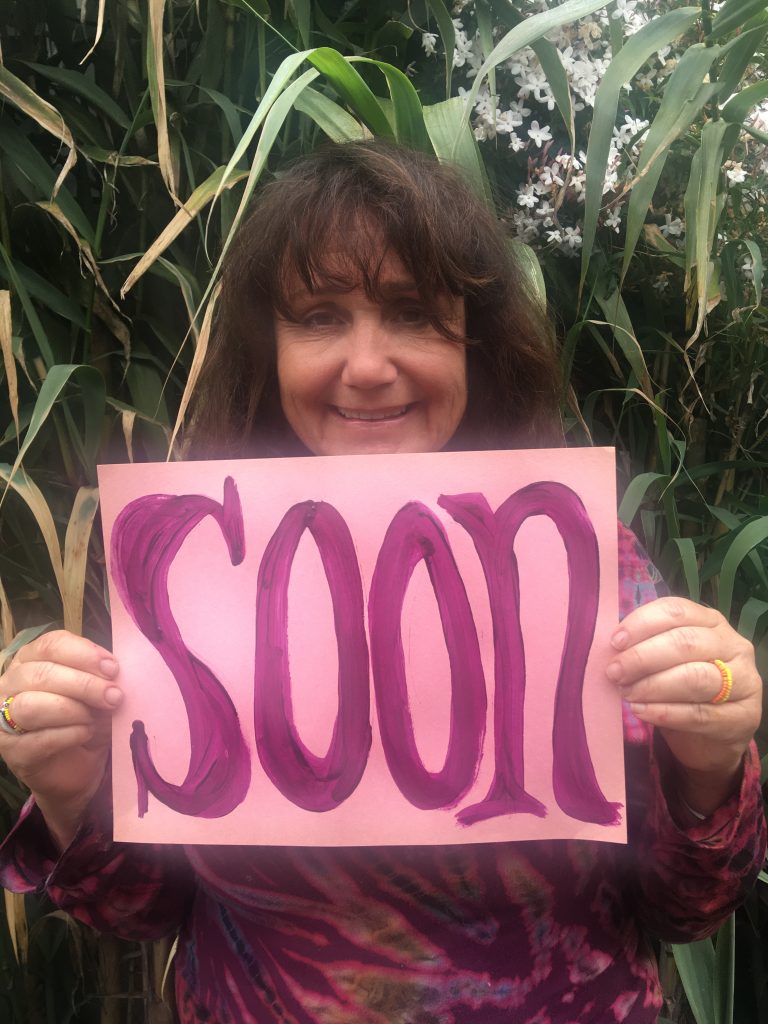
The teachers were instructed to make one word signs, and take a selfie holding the sign. When the pictures were grouped together, it read “We miss you! We will see you soon.” I held the ‘soon’ sign. But we never saw the kids again that year, or the next. In fact, I never saw that group of kids at that school again.